Monday, February 8, 2016

Timna Time!

Hello to all my followers!I hope everyone is having a good February and enjoyed the Super Bowl Yesterday. In this post I will share with you my experience at the excavations in Timna in which I participated for ten days. This post may get a bit long, so bear with me.

Timna Valley and King Solomon's Pillars
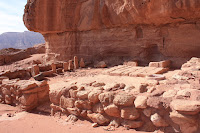
I spent the last week of January and the first few days of February at the Central Timna Valley excavations. Timna is located about 30 kilometers north of Eilat in the Arabah Valley. A rich source of copper, the area has been home to copper mining and smelting for over 5000 years. Extensive mining and smelting remains exist from the Late Bronze Age, controlled by Egypt, and the early Iron Age around the 10th century. Timna is also famous for King Solomon's Pillars (an eroded sandstone formation), other interesting-looking sandstone structures, as well as the Hathor Temple.

A slag mound
This season the excavations were being conducted at Site 34, also known as Slaves' Hill, and at Site 35. Slaves' Hill is a large hill in the middle of the valley with a surrounding wall, a gate house, smelting installations, and other features. The date of the site is placed within a 150-year period from the early 10th century to the middle 9th century BCE. The top of the hill is covered in slag mounds, deposited there by the smelters during the process of creating metal copper. Slag is the stony-glass waste left over after the ore has been smelted. Site 35, located a bit south-east of Slaves' Hill, is an open area in the valley dotted with rectangular structures and small slag mounds. Site 35 is tentatively dated to the Late Bronze Age, around 1300 BCE.

Site 34/Slaves' Hill
Timna Park, run by the Parks Authority, is a well-equipped camping area that hosts tourists year-round. They have small tents, large tents, and cabins, a gift shop and a restaurant. There is also a reconstruction of the Tabernacle built by the Israelites in the desert. We stayed in the cabins, which was an upgrade from what was expected. In the other seasons everyone stayed in the tents, so we were all very happy for the accommodation change.

Our daily routine began at 5:30 every morning, when we would wake up, get ready and pack our day-bag, eat a quick piece of bread with chocolate spread, drink a cup of coffee, and drive to whichever site we were working at that day. By 6:15 we had already started working, either preparing an area to begin excavations or already digging. Sometime between 9-9:45 we stopped for a proper breakfast, which consisted of sandwiches of either cheese or omelet (alternating by day). We took another break a little before noon to have a fruit snack, and then finished the morning's work at 2pm. After getting back to camp we ate lunch provided for us in the restaurant, and then had an hour of rest.

The copper mines
At 4pm we went back to work processing our finds. This involved sifting and sieving buckets of dirt that had been brought back from the field, as well as picking through the separated materials for small finds such as seeds. After several days some of us also began packaging the dirt into small containers that would then be shipped to different labs for analysis. We did this processing until it was time to go for discussion, which occurred any time during the six o'clock hour. Each evening a different veteran of the excavation presented their scientific research to the rest of the group. We had lectures on archaeomagnetic dating, optically stimulated luminescence, stone tools, and other aspects important to Timna's history. After the discussion some people went to bed, while others stayed up for some time hanging out and talking before turning in.

The first few days I worked at Site 35, in an area of the excavation square named the 'animal pen'. The area was a large oblong space surrounded by a wall, too wide to be covered by a roof (hence its identification as a courtyard or pen). I worked in this area along with several other participants, and we found a decent amount of archaeological material. After several days at Site 35 I was moved to Site 34/Slaves' Hill, where I worked at the gate house sifting dirt. Friday I was working back at Site 35 opening a new area of excavation.
Hathor Temple

On Saturday we had a more relaxing day, doing a ground survey of the area around Site 35. We spread out in rows and systematically walked areas collecting finds such as stone tools and pottery. This activity is important for identifying new areas that may be excavated in the future. Saturday afternoon we had a tour of important sites within Timna Park. We visited the Hathor Temple, some of the mines, and Site 34/Slaves' Hill. The Hathor Temple is an Egyptian and Midianite shrine dedicated to the goddess Hathor, who was the patron of mining and smelting. Nearby is a hieroglyphic inscription on the cliff-face depicting Pharaoh Ramses III worshiping Hathor.

I ended the ten days working on Slaves' Hill in an excavation probe. The probe was a small square on a hill opposite the main excavation site at Site 34. The square had been opened the previous season, but in the last three days a few of us cleaned up the erosion and finished the excavation down to bedrock. We found two man-made features, but nothing else very exciting.

That basically sums up my ten days excavating at Timna! I was so happy to be properly excavating again. I met some really cool and professional people, made some great friends, and learned a lot about archaeological science. I'm so thankful to have had the opportunity to work with Erez Ben-Yosef and his team. I'm looking forward to coming back for the excavations next year!
The Central Timna Valley 2016 excavation team
Attached here is the link to all of my photos, for those that don't look at or don't have Facebook. It includes all the photos I've taken while I've been here in Israel, including some of the less spectacular ones that I choose to omit from publishing on Facebook. The link will work no matter how many photos I add, so saving this link will always show you the most up to date files.
https://www.dropbox.com/sh/rzg8dgcag9yjjx7/AADeP0ft-J6r_xxApFqm7p1xa?dl=0

Friday, January 22, 2016

End of the Semester Post

Welcome back! This is my last post for the semester. Classes ended last Wednesday, with a tour on Thursday and a make-up class on Sunday. I'll talk a little bit about how the end of the semester went, and then give a preview of what my vacation is going to look like.

The Sunday after our trip to Megiddo (before the last week) we had a make-up class since some of our professors have needed to cancel their normally-scheduled lessons. The class was fine, not really worth mentioning. After the class, however, I organized an impromptu trip to Jerusalem! A few of my friends and I took a taxi to the Old City after class, and spent the evening touring the area. We walked through the Arab shuk, visited the shops and remains of the Roman Cardo, and arrived at the Kotel. Then we walked around outside the walls. We visited the Giv'ati parking lot, where recent excavations have unearthed the infamous Hellenistic 'Akra. We've talked a lot about it in our classes, but actually seeing the site brought us a whole new understanding. We ended our trip to Jerusalem with a quick walk down Ben Yehudah St.

The last week went pretty uneventfully. We wrapped up our history course, discussing the end of the Hellenistic and Hasmonean Periods. We finished looking at the stratigraphy of Megiddo. We began looking at some of the things we will be doing next semester. Three of our classes were only for the first semester, and they are now done. We are no longer taking the Megiddo seminar, the Text and Image workshop, and the intro history course. Instead next semester we will start three new classes. There will be a pottery typology class, a class on archaeological science, and a different class about history of the region. That last one I'm not too sure what it's going to be about, since it seems similar to what we already took. But we'll see!

Last Thursday we had a field excursion to the site of Beit Guvrin/Tel Maresha. The tour started at the tel, but there isn't much to see. A bit of the fortification is visible on the surface, but very little of it is left exposed after it was excavated and back-filled in the early 20th century. After walking on the tel we saw parts of the later city, which includes the famous caves, cisterns, columbaria, and tombs in the national park that date to the Hellenistic Period.We walked through several of the caves, and then went and saw the Roman city, with its amphitheater and bathhouse. That is how the semester ended.

Now for the look ahead. Starting now, we have no classes until February 29th. Yes, we have nearly 6 weeks off. That doesn't mean we don't have work to do, however. To really finish up the semester, we have three papers to write for the classes we are completing. These papers are due during the vacation, so we aren't off the hook yet. This time is also the perfect opportunity to go on trips around the country, or to go abroad. Some of my classmates are taking trips to Europe, or to go back to their place of origin. I, however, am staying here, filling up my time with things to see in Israel.

The most exciting thing I will be doing is going on an excavation. Starting this coming Sunday (at 5am) I will be participating in the excavations at the site of Timna, in the Negev near Eilat. The season is 10 days long, working every day. I am really looking forward to getting back in the field and working!

After the excavations are over I have to get hard to work writing my papers. During the remaining several weeks I hope to take several trips around the country. I have already made plans to stay in Jerusalem for a few days, as well as a tour to Masada, Ein Gedi, and the Dead Sea. I'm hoping to go to Akko, Caesarea, and maybe another trip or two. It all depends on how my work goes, and how bad the weather is. My next post will happen some time near the end of the vacation, probably mid-February. Until then everyone!

Attached here is the link to all of my photos, for those that don't look at or don't have Facebook. It includes all the photos I've taken while I've been here in Israel, including some of the less spectacular ones that I choose to omit from publishing on Facebook. The link will work no matter how many photos I add, so saving this link will always show you the most up to date files.
https://www.dropbox.com/sh/rzg8dgcag9yjjx7/AADeP0ft-J6r_xxApFqm7p1xa?dl=0

Saturday, January 9, 2016

The Last Battle for our Academic Lives

Happy 2016 everyone! Hope all of your New Year celebrations were joyous and exciting. Mine was relaxing. I didn't do anything special, and was asleep well before midnight. Classes are still moving along, with one more week left in the semester. The semester break is going to be very busy, with papers and traveling and fun, and I'm excited to reach it.

The past two weeks have been pretty normal. Every week we go to classes, occasionally one of them gets cancelled which gives us a respite. However, this also means that we now have to be worried about needing make-up classes. Sunday, for example, we will be having a make-up class for our Classical Period history course, since we missed the last class as a result of a field trip. While the class is sometimes very interesting, I'm not looking forward to having class on Sunday.

This past Thursday we had a field trip to Tel Megiddo, also known as Armageddon. The site of the Last Battle between the army of heaven and the forces of evil, the site is a major tourist location for people from all over the world. Our professor Israel Finkelstein is the director of the current excavations there, and guided our tour. Being able to visit the site under his guidance was a dream come true for many people in the program, including second-year students. He is an expert in his field and one of the most well-known Israeli archaeologists of the last fifty years.

Since he is teaching a seminar on the Megiddo excavations, the tour focused less on the history and information about the archaeological remains and more on specific details or interesting stories. Much of the tour involved identifying and seeing first-hand the features and locations that we had talked about in class, as well as putting the site into a broader, geographical context. The weather wasn't great, but visibility was good enough to see Mt. Tabor and Mt. Gilboa in one direction and Mt. Carmel in the other direction. The major importance of Tel Megiddo comes from its location at the opening of a path through the Carmel ridge that links the coastal plain, known in antiquity as the Via Maris, with the Jezreel Valley. This route is the easiest and most direct route from Egypt to Damascus and Mesopotamia, and was valued by every major Near Eastern civilization from the Pharaohs to the kings of Babylon. It is even mentioned by name in inscriptions dating back to Pharaoh Thutmoses III.

The importance of stratigraphy and archaeological method is greatly important to Israel Finkelstein, and much of the tour was devoted to identifying and explaining these concepts through the use of the archaeological remains. While it is commonly known that the deeper something is in the ground or the lower its elevation is the older it is, sometimes this is not the case. On Megiddo, for example, the original hill slopes asymmetrically, causing certain areas to be higher than others. When this is combined with building patterns, it is possible that remains on the surface in one area do not always correspond chronologically with remains in another area. For example, there is an area near the gate where the remains at the highest point are in fact older than structures a few meters away and lower in elevation. Without being able to correctly identify and distinguish pottery and architecture types, a completely wrong picture could be assumed based solely on the elevation. Details like this become much more poignant and understandable when viewed in the field and by an expert.

Visiting Megiddo, while an exciting opportunity in its own right, was made even more beneficial to our studies with the presence of Israel Finkelstein. I cannot emphasize enough how much of an educational and significant experience it became for all of us through his unique insight into Megiddo, where he has worked for the past twenty-plus years. No other person in the world knows more about the archaeology and history of this place than Israel Finkelstein, he has given tours to presidents, prime ministers and celebrities, and he took us on a tour of his baby. It was for this opportunity that I came to study at Tel Aviv University.

One more week of classes. We have another tour planned for next Thursday, which will end the first semester. Hopefully they don't pile on too much work for us to do over the six-week vacation! Until next time!

Attached here is the link to all of my photos, for those that don't look at or don't have Facebook. It includes all the photos I've taken while I've been here in Israel, including some of the less spectacular ones that I choose to omit from publishing on Facebook. The link will work no matter how many photos I add, so saving this link will always show you the most up to date files.
https://www.dropbox.com/sh/rzg8dgcag9yjjx7/AADeP0ft-J6r_xxApFqm7p1xa?dl=0

Friday, December 25, 2015

In the Field and In the Classroom

Welcome back to my blog! It's been a few weeks, so there is a lot of material to catch up on. Hanukkah is over, and today is Christmas! For anyone that celebrates it, have a merry Christmas!

The Coastal Plain
I believe I left off last post before our first trip to the field. We had a tour of several archaeological sites near Tel Aviv, hosted by Dr. Yuval Gadot, one of our professors. We went to a couple small sites as well as Aphek and Jaffa, and saw the archaeological material that we had been discussing, especially for the Bronze Age. The tour focused on sites that controlled the road along the coast, at the foothills of the highlands. At the site of Migdal Tzedek we could see the flat lowlands on one side, and the foothills on the other. It really made the material come to life to see how this narrow strip of land was the only easy path from south to north. It was wonderful to finally get out in the field and see everything, as opposed to just reading about it in articles and books.

The school work is starting to pick up, and we have had several papers to write and several more on the way. We are starting to look at the bigger picture in many of our classes, and have discussed the implications of many different events. One of the most fascinating events that we have discussed is the destruction of the territory of Judah by Sennacherib, emperor of Assyria, in 701 BCE. While he didn't destroy Jerusalem, his actions had major ramifications for the next three thousand years. Sennacherib's campaign is probably one of the most influential events on the formation of Judeo-Christian theology. The fact that Jerusalem was not destroyed led to its sanctification as the place that God had chosen, and this has affected every generation till today.

Hanukkah came to an end, and with it the winter celebrations. I spent the last night in much the same way I spent the first night, with friends in the city. We watched the large chanukiyah be lit at Rabin Square and then partied at several bars. It was a great way to end the holiday.

View of the Judean Hills
We had a second tour the following week, looking at sites in the Judean Lowlands. Dr. Omer Sergi took us to the sites of Bet Shemesh, Azekah, and Gath, where he discussed the importance of the sites, their geopolitical background, and the excavations there. Tel Bet Shemesh is a small site, but because it is almost completely surrounded by hills it probably was afforded some measure of security. Azekah, situated at the tip of a ridge that splits the area east from west, was an important site for controlling the pass from the coast to the highlands. From Azekah you can see the highlands surrounding Jerusalem, the ridge bordering Hebron, and the lowlands that approach the coast. Gath was the largest city in the southern Levant during the early Iron Age, and has impressive fortifications both on the tel and surrounding the lower city. The Iron Age ruins are extremely easy to identify, in some places protruding from the surface. The site is enormous and very intimidating. It makes it easy to imagine how the rulers could command the populace surrounding the city.
A partial view of Gath

As the year 2015 approaches its end, I have a lot about which to think and reflect. I have really been enjoying my studies here in Tel Aviv. While I haven't always agreed with everything we do, and I often question the format and planning of the program, I am very grateful for this amazing opportunity to study archaeology and history here in Israel. To study under the guidance of the most influential scholars in the field, being taught by the men and women who have done the work in the field that we read about in the articles and books, is a great honor and one that I would never pass up.

I hope every one has had a wonderful Hannukah, Christmas, Festivus, or whichever winter celebration you choose to celebrate, and that everyone has a safe, enjoyable, and exciting New Year!

Attached here is the link to all of my photos, for those that don't look at or don't have Facebook. It includes all the photos I've taken while I've been here in Israel, including some of the less spectacular ones that I choose to omit from publishing on Facebook. The link will work no matter how many photos I add, so saving this link will always show you the most up to date files.
https://www.dropbox.com/sh/rzg8dgcag9yjjx7/AADeP0ft-J6r_xxApFqm7p1xa?dl=0

Tuesday, December 8, 2015

Hiking and Hanukkah

Hey guys, it's been a while. Here's an update to what's been going on the last several weeks, what I've been doing, and all the holiday celebrations!

The excavations are over for the season at Aphek. The last day was the Friday after Thanksgiving, November 27th, but I did not participate. That weekend I went to Bet Shemesh to celebrate Thanksgiving with my aunt and uncle. Thursday after class I traveled there, and we had a delicious, traditional Thanksgiving dinner. There was turkey, stuffing, corn bread, and may other seasonal staples. It was really great to celebrate the American holiday while outside the country.

I spent Shabbat in Bet Shemesh, which is always a nice experience. Cousin Hannah came for Shabbat dinner, but didn't stay. After Shabbat was over my aunt and uncle were going to Tel Aviv for a party, and they drove me back so I didn't have to take a bus. The rest of the weekend was devoted to preparing for the work due during the coming week.

The week was pretty uneventful. There were readings, papers, and studying to be done every day. The excitement came that weekend, when Tel Aviv University International hosted a 2-day hiking trip around Mitzpe Ramon. It was a very large group, so we split into two smaller groups and did everything just with our group, only meeting the other group a few times. We left early Friday morning and drove down near Sde Boker and went on a hike. We passed a small watering hole, where we took a rest. The hike culminated in a very large ascent, that was both unexpected and extremely challenging. I really enjoyed it, even though I was exhausted and sore by the end. After the hike we drove to a hostel overlooking Ramon Crater, dumped our stuff, and then went to a Bedouin tourist center for dinner. The food was really delicious, and after we sat around a bonfire eating marshmallows. The night ended with us going to a small bar. I wasn't looking forward to it, but it surprised me. It was very mellow and quiet, and had hot cider. It was the perfect way to end the day.


Saturday morning we had breakfast in the hostel, packed up to leave, and started a hike down the crater. The path was somewhat steep and very rocky, which made it easy to slip and fall. The view out over the crater was very scenic, and I think everyone enjoyed the experience. One thing that almost everyone complained about, however, was how cold it was. The wind was always blowing, and even in the sun we had to stay bundled. I really enjoyed looking at the geology and rock features, and had a great time the entire day. After we made it to the bottom the buses picked us up and we drove to the Orlyya Farm. There we met a local farmer who created a life for himself and his family in the desert growing herbs and Moroccan Oil (Argan) trees. After learning about his lifestyle we drove to the Sde Boker Winery and had a wine tasting. After four cups of wine, we sleepily piled into the buses and made our way back to Tel Aviv.

The hike was a great experience. Walking through the desert in the Ramon Crater, while something that I have done before, brings a new experience every time. After the hike, however, I had a lot of work to do. Sunday a paper was due, and I needed to finish it before I could do anything else fun.

Sunday night saw the beginning of Hanukkah. An eight-day festival of lights, it is a big celebration here in Israel. For the first night I went to Independence Park, where there were crafts, jelly donuts, and candle-lighting. They also gave out personal chanukiyot so everyone could light at home. Second night I went to a party for young Jews, hosted by Nefesh b'Nefesh at Moishe House. They served latkes, snacks, and lots of wine. It was a great opportunity to meet other Jewish young adults while celebrating the holiday. One thing that I'm finding so fascinating and inspiring is how involved the entire city is in the holiday. I know I shouldn't be surprised that Israel, the Jewish state, takes Jewish holidays seriously, but when I'm walking through the streets and there are people at every other corner giving out chanukiyah kits or jelly donuts it just makes everything seem better. The municipal building in the center of Tel Aviv lights up its windows every night in the shape of a chanukiyah, with a new candle lit each night. And all over campus, people walk around carrying boxes of donuts, just handing them out. It really feels wonderful.

As the holiday continues the events around campus and the city continue. There are parties or lighting ceremonies every night. Also, this Friday we are going on our first archaeological field trip. I am really excited to finally get out and visit the sites. Hopefully it will be full of information as well as fun.

Attached here is the link to all of my photos, for those that don't look at or don't have Facebook. It includes all the photos I've taken while I've been here in Israel, including some of the less spectacular ones that I choose to omit from publishing on Facebook. The link will work no matter how many photos I add, so saving this link will always show you the most up to date files.
https://www.dropbox.com/sh/rzg8dgcag9yjjx7/AADeP0ft-J6r_xxApFqm7p1xa?dl=0

Friday, November 20, 2015

Excavating and Teaching

Welcome back! Sorry it took so long for an update, but the last several weeks have been extremely busy. We've had a lot of school work thrown on us which has caused a lot of stress, and that has taken its toll on many of us. However I think I can safely say that the worst has passed and most everyone is feeling better about things.

I believe since my last post I have a few new things to mention. I've unofficially and informally joined an excavation at the site of Tel Aphek/Antipatris. The site is located just outside the town of Rosh Ha'ayin, at the headwaters of the Yarkon River. The site has habitation layers from the Bronze Age (~1500 BCE) all the way to the Ottoman Period. The excavations run by Tel Aviv University are in an area of a Canaanite Palace dating to the Bronze Age. Most of the site has been excavated before, so we are finding a lot of fill material, such as barbed wire, modern glass, plastic, and chewed gum.

I have been to the site twice now, last Friday and this Friday (today). I have been working with several others in one square, trying to make the floor level before lowering it down to the elevation of the Canaanite Palace. The Bronze Age level is more than a meter beneath the current level, and the work will not be completed after only one season. Right now we are digging through part of the Roman level, and are finding some typical Roman pottery (in addition to the modern fill material). Today part of my job was filling sandbags to line the bulks and edges of the excavation squares. 'Sandbags' is a misnomer, since the bags are actually filled with the dirt that we excavate from the square. The boss was happily surprised by my technique and complimented the look and professionalism of the sandbags I made, He put me in charge of the sandbag job, which surprised me since I have never done that kind of work before.

One aspect of the Aphek excavations is the inclusion of children and non-academics in the excavation process. Each week a large part of the team consists of normal people that have chosen to wake up really early and participate in the dig. Children from a local school are also brought to the site to help out and learn more about archaeology. Part of our job as the 'expert excavators' is to teach the others about the archaeological process, the techniques, methods and terminology, as well as the reasons behind those methods and the excavations themselves. The children, while not able to do the heavy digging or more delicate work, can also participate by moving loose stones or washing the potter that has already been found. They really enjoy it because they feel like they are helping the professionals (us) with our work, which they are! It also exposes them to a part of the history that they may never experience, or only experience to a limited extent. Plus it's a chance for them to practice English (and for me to practice Hebrew)!

The winter rainy season has come, which limits the time excavations can be held. This means that there may be only one more day of excavations before the squares are closed for the winter. The decision hasn't been made yet, but even if I've excavated my last day at Aphek I have learned quite a bit and am glad I went. I have signed up for another dig in January down in the Negev, but the details for that have not been released yet.

I hope all my American followers have a relaxing and stomach-bursting Thanksgiving. Hanukkah is coming up soon, so my next post will probably cover that festive time!

Attached here is the link to all of my photos, for those that don't look at or don't have Facebook. It includes all the photos I've taken while I've been here in Israel, including some of the less spectacular ones that I choose to omit from publishing on Facebook. The link will work no matter how many photos I add, so saving this link will always show you the most up to date files.

https://www.dropbox.com/sh/rzg8dgcag9yjjx7/AADeP0ft-J6r_xxApFqm7p1xa?dl=0

Sunday, November 8, 2015

1 Month In, 2 Weeks of Rain

Hey everyone! The program is now around one month old, and things are starting to go at a regular pace. This post is somewhat light on content and events, so if you have any questions feel free to ask in the comments and I will be more than willing to answer!

The few weeks since my last post have been mostly uneventful. I go to classes Mon-Thur, I read various articles about various aspects of archaeology in the Southern Levant, I eat, I sleep, I do laundry, I try to avoid the rain. Yeah, we've had a lot of rain recently. I haven't been keeping track, but I'm pretty sure it has rained for at least an hour at some point every day for the last two weeks. And not just a light drizzle, either. They have been storms, complete with thunder and lightning. This is great for the country as a whole, but a real bummer for us who like to do things outside.
Identifying sherds

This past Friday we were supposed to go on our first field trip to the sites of Gezer and Aphek, but we had to cancel on account of thunderstorms. Instead we had an impromptu lesson on pottery in the Bronze and Iron Ages. You can see some of the pictures from the lesson I posted on Facebook. I was definitely disappointed that we didn't get to go to the sites, since they were two sites that I had never been to before. However, the day wasn't a loss as the typology lesson was very educational. Some parts of it were review, like how to identify and label different parts of a vessel (neck, base, rim, etc.), but seeing actual examples of the pottery we were discussing in our classes was very useful.
Philistine wine krater


'Bilbil' jug
The classes themselves have been interesting as a whole, with some more educational than others. Since the professors teach classes for our program as well as courses in Hebrew for Israeli students (and sometimes courses for other departments), juggling classes sometimes leads to overlap. This means sometimes we won't have one of the classes one week, and may have a different class more times than is scheduled. As long as we are learning, I have no complaints.

Starting this week we will begin our discussion of the Iron Age, and the time periods discussed in the Bible. It is going to be very interesting to see what people think about the different interpretations and outlooks towards archaeology and the Bible, and to see how professional archaeologists tackle the issue as well.

We have received our first written assignments, so the next couple weeks will be mostly devoted to doing research and writing for those. I hope everyone has an enjoyable and productive week. Feel free to ask questions, and stay out of the rain!